
Nominee director services are one of the most widely used — and most frequently misunderstood — tools in the UAE corporate toolkit. Used correctly and documented properly, they serve legitimate and important purposes: enabling foreign investors to meet local governance requirements, providing a degree of privacy in public company records, and supporting multinational governance structures. Used loosely or without proper legal foundations, they create compliance exposure, banking complications, and governance risk.
This guide explains what nominee director services in the UAE are, when they are genuinely needed, how UAE law governs them under the UBO regulations, and what must be in place before any nominee arrangement can be considered properly structured.
What Is a Nominee Director?
A nominee director is an individual appointed to appear on a company’s official records as a director, while acting on the instructions of the beneficial owner — referred to as the appointer — rather than exercising independent commercial judgment. The nominee’s name appears in company registers and regulatory filings; the beneficial owner retains actual control.
In practice, a nominee director attends board meetings, signs documents, and represents the company in official and regulatory capacities — but only within the scope defined in a nominee director agreement. They hold no beneficial interest in the company and are not entitled to make decisions that the beneficial owner has not sanctioned.
UAE law recognises a related and equally important concept: the shadow director. Under the UAE UBO Regulations — introduced by Cabinet Decision No. 58 of 2020 — a shadow director is anyone whose instructions the board habitually follows, even if they hold no formal director title. Shadow directors are treated identically to formal nominees under the regulations: they must be disclosed in the company’s Register of Nominee Directors and reported to the relevant authority. There is no meaningful compliance distinction between a formal nominee arrangement and an informal one.
When Is a Nominee Director Used in the UAE?
There are several legitimate, commonly encountered scenarios in which a nominee director serves a genuine commercial purpose:
- Resident director requirements: certain UAE freezone authorities and some regulated sector licences require at least one UAE-resident director on the board. Foreign beneficial owners who are not resident in the UAE appoint a qualified resident nominee to satisfy this requirement.
- Privacy in public company records: while the UAE’s UBO register is a confidential government document (not publicly searchable), other company records — including commercial licences and some freezone registries — may reference director names. A nominee arrangement can limit the beneficial owner’s personal exposure in public-facing records.
- Multinational subsidiary governance: large international groups often appoint local nominee directors to provide a resident governance presence for UAE subsidiaries without relocating a senior executive or requiring a board member to travel for routine filings.
- Regulated sector requirements: certain licensed activities — including financial services, healthcare, and education — require directors to hold specific qualifications, UAE residency, or regulatory approvals. A nominee who satisfies those criteria can hold the formal position while the beneficial owner drives operations.
- Interim governance: during company setup, director transitions, or ownership restructuring, a nominee provides continuity and ensures the company remains properly governed throughout the process.
An important context note on the mainland: prior to the Federal Decree-Law No. 32 of 2021 on Commercial Companies, mainland UAE companies required 51% UAE national ownership. This drove widespread use of nominee shareholders — a UAE national would hold shares on behalf of a foreign beneficial owner. Since 2021, most mainland sectors permit 100% foreign ownership, which has largely eliminated the primary historical driver of nominee shareholder arrangements on the mainland. Nominee directors (a separate concept) remain relevant and in use, but the legal landscape has changed materially.
The UAE Legal Framework: What Governs Nominee Directors?
Nominee director services in the UAE operate within a clear and increasingly rigorous legal framework. Three pieces of legislation are most directly relevant:
- Federal Decree-Law No. 32 of 2021 (Commercial Companies Law): governs director duties, appointment processes, and corporate governance obligations for mainland UAE companies. Directors — including nominees — owe fiduciary duties to the company and are personally liable for actions taken within their authority.
- Cabinet Decision No. 58 of 2020 (UBO Regulations): introduced the mandatory Register of Nominee Directors as a compliance document for all mainland and non-financial freezone companies. Companies must maintain this register at their registered office and submit it to the relevant authority within 15 days of any nominee appointment, change, or termination. Nominees themselves are also legally required to disclose their status to the company within 15 days of taking up their role — this is an obligation on the nominee, not only on the company.
- Federal Decree-Law No. 20 of 2018 (AML/CFT Law): under the UAE’s anti-money laundering framework, nominee arrangements are automatically treated as higher-risk by financial institutions and corporate service providers. UAE banks conducting KYC on companies with nominee directors are required to conduct enhanced due diligence and must understand the true nature of the arrangement. An undocumented or improperly structured nominee arrangement will typically trigger banking complications.
DIFC and ADGM companies are exempt from Cabinet Decision No. 58 of 2020 — but are not exempt from equivalent obligations. Both financial free zones operate their own nominee director and beneficial owner disclosure frameworks under their respective company laws, with requirements that are broadly comparable in stringency to the federal regime.
What a Nominee Director Does Not Change: UBO Disclosure
The most important compliance reality to understand about nominee director services in the UAE is this: a nominee arrangement does not eliminate the obligation to disclose the beneficial owner to UAE authorities.
Under Cabinet Decision No. 58 of 2020, the ultimate beneficial owner — any natural person who directly or indirectly owns or controls 25% or more of the company’s shares or voting rights, or who exercises effective control by other means — must be disclosed in the company’s Register of Beneficial Owners and filed with the relevant regulatory authority.
The UBO register is not publicly searchable. It is a confidential government record accessible only to relevant authorities. This means a nominee arrangement can limit a beneficial owner’s exposure in public-facing company records — but it does not render them invisible to UAE regulators, financial intelligence authorities, or banks. Any arrangement structured on the assumption that beneficial ownership will be hidden from UAE authorities is both legally non-compliant and practically unworkable under the current AML framework.
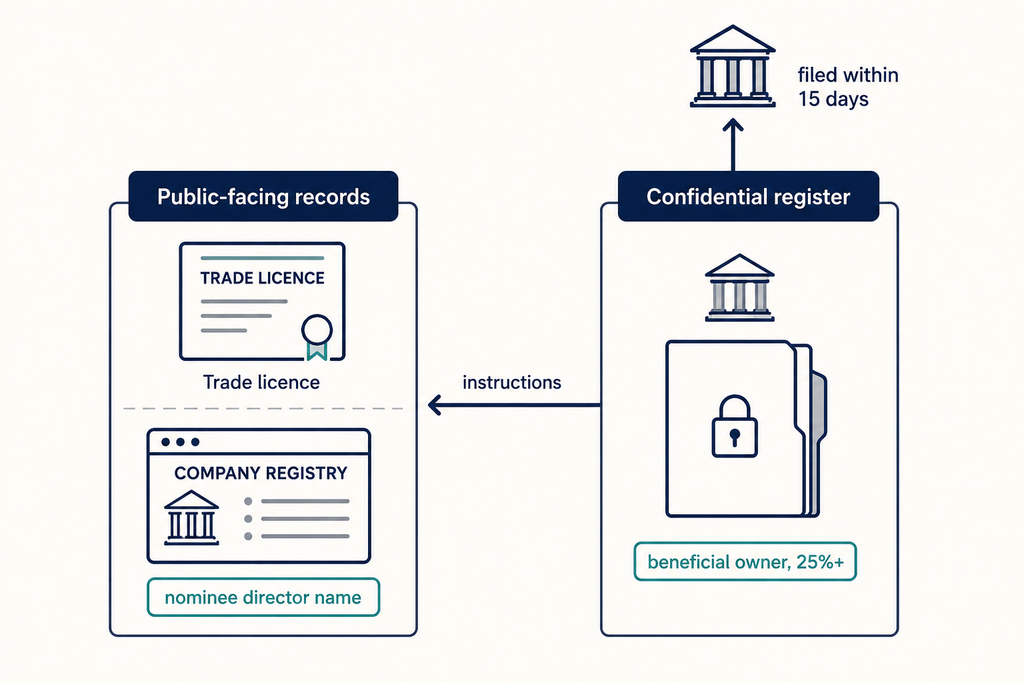
Any changes to beneficial ownership, nominee director arrangements, or related company information must be reported to the relevant authority within 15 days. Non-compliance can result in administrative fines, licence suspension, and referral under UAE AML legislation.
What Must Be in Place Before Appointing a Nominee Director
A compliant, well-structured nominee director arrangement requires several documents and controls to be in place before — not after — the nominee takes up their role:
- Step 1: A binding Nominee Director Agreement setting out the nominee’s scope of authority, the instructions mechanism, indemnification provisions, confidentiality obligations, and clear termination grounds. Without this, the nominee has no legally defined boundaries and the beneficial owner has limited recourse if they act beyond the intended scope.
- Step 2: A Power of Attorney (POA) granted to the beneficial owner, giving them direct authority to act on behalf of the company. This ensures the beneficial owner retains practical control in parallel with the nominee’s formal position.
- Step 3: A signed undated resignation letter from the nominee, held by the beneficial owner. This gives the owner the ability to remove and replace the nominee immediately and without procedural delay if needed.
- Step 4: Banking controls: the beneficial owner should retain control over banking mandates, authorised signatories, and payment authorities. Nominee directors should not have unilateral access to company accounts.
- Step 5: UBO and nominee registers maintained and filed: both the Register of Beneficial Owners and the Register of Nominee Directors must be established, accurate, and submitted to the relevant authority within the required timelines.
- Step 6: Annual review: nominee arrangements should be reviewed and reconfirmed at least annually, and updated whenever there are changes to ownership, business activity, or applicable regulation.
Provider quality matters: nominee directors should be appointed through established corporate service providers, law firms, or licensed professional service organisations — not through informal personal arrangements. Unqualified or undocumented nominees present significant governance, compliance, and banking risk, and may themselves become a liability rather than an asset.
Structure Your Nominee Arrangement with Rosemont
Nominee director services are a legitimate and useful component of corporate structuring in the UAE — when they are documented correctly, compliant with UBO regulations, and supported by the right legal instruments. The risk is not in using a nominee director; the risk is in using one without the proper framework in place.
Rosemont advises on and structures compliant nominee director arrangements for businesses across the UAE — from mainland companies and commercial free zones through to ADGM and DIFC. We ensure that nominee arrangements are properly documented, legally sound, and fully aligned with UAE UBO and AML obligations, while protecting the governance interests of beneficial owners throughout.
Contact Rosemont today for a confidential consultation on nominee director services in the UAE.