
Since the introduction of UAE corporate tax, transfer pricing has become a core compliance obligation — not a concern reserved for large multinationals. If your company transacts with related parties or connected persons — a group company, a shareholder, a director, or a business owned by family — those transactions must be priced at arm’s length and, in many cases, documented and disclosed to the Federal Tax Authority (FTA). This guide explains the arm’s-length principle, who the rules catch, the three documents that make up UAE transfer pricing compliance, the thresholds that trigger them, and how it all fits together. For the general regime, see our corporate tax compliance guide.

What Is Transfer Pricing?
Transfer pricing is the pricing of transactions between parties that are not independent of each other — typically companies within the same group, or a company and its owners. Because related parties can set prices between themselves, tax authorities require those prices to reflect what independent parties would have agreed in a comparable transaction. The aim is to prevent profit being shifted — deliberately or not — to where it is taxed least. Under UAE corporate tax, these rules apply to both cross-border and domestic related-party transactions.
The Arm’s-Length Principle
At the centre of UAE transfer pricing is the arm’s-length principle, set out in Article 34 of the Corporate Tax Law. It requires transactions between related parties to be priced as if they had taken place between independent parties under comparable conditions. Where they are not, the FTA can adjust your taxable income to the arm’s-length result. To test and evidence an arm’s-length price, the UAE follows the OECD’s five recognised methods:
- Comparable Uncontrolled Price (CUP)
- Resale Price Method
- Cost Plus Method
- Transactional Net Margin Method (TNMM)
- Transactional Profit Split Method
Another method may be used where none of these is appropriate, provided the choice can be justified.
Who Does It Apply To? Related Parties and Connected Persons
Transfer pricing applies to transactions with two categories of counterparty:
- Related parties (Article 35): broadly, parties linked by ownership or control of 50% or more, or — for individuals — by kinship up to the fourth degree, along with a company and its branches.
- Connected persons (Article 36): an owner of the business, a director or officer, and any of their related parties — which captures, for example, salaries, rent and payments made to shareholders and directors.
Crucially, the rules are not limited to international groups. Payments between two UAE companies under common ownership, or a management fee paid to a shareholder, are squarely within scope — and this is where owner-managed businesses most often get caught.
| A common misconception“Transfer pricing is only for big multinationals.” In the UAE, even a small company that pays salary, rent or a management fee to its owner must be able to show that payment is set at market value. |
Transfer Pricing Documentation: The Three Documents
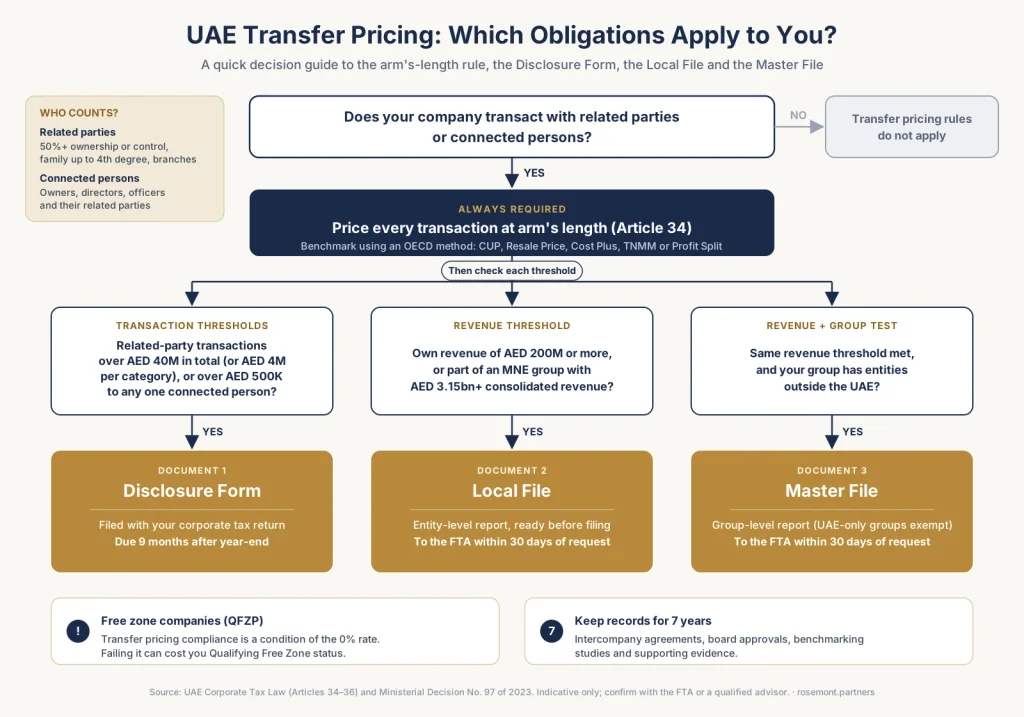
UAE transfer pricing compliance is built on three documents, each triggered at a different level:
1. The Transfer Pricing Disclosure Form
A schedule filed with your corporate tax return that declares your related-party and connected-person transactions by type and value. Broadly, it is required where related-party transactions in aggregate exceed AED 40 million — with a per-category threshold of AED 4 million for goods, services, financing or IP — and where payments to any one connected person and their related parties exceed AED 500,000. It is due with the return, nine months after the end of your tax period.
2. The Local File
An entity-specific report detailing your controlled transactions — the functions performed, assets used and risks assumed, the transfer-pricing method chosen, and the benchmarking that supports the price.
3. The Master File
A group-level report giving a high-level overview of the multinational group’s global business, its transfer-pricing policies, and its allocation of income and economic activity.
Who Must Prepare a Master File and Local File?
Not every business needs the full documentation. Under Ministerial Decision No. 97 of 2023, a Master File and Local File are mandatory where a taxable person either has its own revenue of AED 200 million or more in the tax period, or is part of a multinational group with consolidated revenue of AED 3.15 billion or more.
| Document | When it applies | When it’s due |
|---|---|---|
| Disclosure Form | Related-party transactions above the reporting thresholds | With the CT return (9 months after year-end) |
| Local File | Own revenue ≥ AED 200M, or MNE group ≥ AED 3.15bn | Held on file; to the FTA within 30 days of request |
| Master File | Same thresholds (UAE-only groups are exempt) | Held on file; to the FTA within 30 days of request |
A useful carve-out: if your group operates only in the UAE, with no foreign entities, you are not required to prepare a Master File — though you still need a Local File if you cross the AED 200 million threshold. Both files must be ready before you file and provided to the FTA within 30 days of a written request, and records should be retained for seven years. Note too that being below the file thresholds is not the same as being below transfer pricing: every taxable person with related-party dealings must still price them at arm’s length and complete the disclosure form where it applies.
Transfer Pricing and Free Zone (QFZP) Companies
For free zone companies, transfer pricing is not optional. Compliance with the arm’s-length principle and the related documentation is one of the five conditions of being a Qualifying Free Zone Person (QFZP) — and a free zone company that fails its transfer-pricing obligations can lose its 0% rate.
Penalties and FTA Scrutiny
Transfer pricing has moved from theory to enforcement. The FTA now actively requests Master and Local Files as part of risk-based corporate tax audits — and when it asks, the 30-day clock starts. Weak or missing documentation exposes you to transfer-pricing adjustments (the FTA restating your taxable income to the arm’s-length result), additional tax, and administrative penalties. The practical risk is not only the adjustment but the speed: a file that does not already exist cannot be built in 30 days.
How to Stay Compliant
- Map your related parties and connected persons, and identify every intra-group and owner transaction.
- Set a written transfer-pricing policy and apply it consistently across intercompany invoices and agreements.
- Benchmark material transactions to evidence arm’s-length pricing.
- Complete the disclosure form with your return where the thresholds are met.
- Prepare the Master and Local File before filing if you cross the revenue thresholds — don’t wait for the FTA to ask.
- Keep intercompany agreements, board approvals and supporting records for seven years.
How Rosemont Partners Helps
At Rosemont Partners, we help businesses meet their transfer-pricing obligations end to end: mapping related parties and connected persons, drafting defensible transfer-pricing policies, preparing benchmarking studies, completing the disclosure form, and building Master and Local Files that stand up to an FTA request — aligned with your corporate tax and, where relevant, free zone position. To review your transfer-pricing exposure, get in touch with our team.
Frequently Asked Questions
Does transfer pricing apply to small UAE businesses?
Yes. Full Master and Local File documentation is only required above AED 200 million revenue (or AED 3.15 billion group revenue), but every business with related-party or connected-person transactions must price them at arm’s length and may need to file the disclosure form.
What is the arm’s-length principle?
The requirement that related-party transactions be priced as independent parties would have priced them in comparable conditions.
What’s the difference between a related party and a connected person?
A related party is linked by ownership, control or kinship; a connected person is an owner, director or officer (and their related parties) — which brings payments such as salaries and fees to shareholders into scope.
When do I need a Master File and Local File?
When your own revenue is AED 200 million or more, or you are part of a multinational group with consolidated revenue of AED 3.15 billion or more.
How long do I have to give the FTA my documentation?
Generally 30 days from a written request for the Master and Local File. The disclosure form is filed with your return.
Does transfer pricing affect free zone 0% status?
Yes — transfer-pricing compliance is one of the five conditions of being a Qualifying Free Zone Person.